EPA Technician Certification Program

Take the next step toward becoming a qualified HVAC/R professional with the EPA Section 608 Technician Certification Exam. This nationally recognized certification is essential for technicians who maintain, service, repair, or dispose of equipment that could release refrigerants into the atmosphere. Whether you are preparing to enter the industry, expand your qualifications, or strengthen your career opportunities, earning this certification demonstrates your knowledge, professionalism, and readiness to work in accordance with federal environmental regulations.

Under Section 608 of the Clean Air Act, technicians who handle regulated refrigerants must be properly certified. For employers, this certification represents competence and credibility. For students and technicians, it opens the door to greater opportunities in residential, commercial, and industrial refrigeration and air conditioning work. From small appliances to large cooling systems, certified technicians are trusted to perform their work safely, responsibly, and in compliance with EPA requirements.

This examination is more than a legal requirement. It is an important professional milestone. Passing the EPA Section 608 exam shows that you understand refrigerant recovery, recycling, leak prevention, safety procedures, ozone depletion concerns, and proper environmental practices. It is one of the most valuable credentials a technician can hold in the HVAC/R field, and it can help distinguish you in a competitive workforce.

For individuals who already have technical knowledge of refrigeration systems, this is an excellent opportunity to validate your skills and move forward with confidence. Earning your certification can increase your value to employers, support career advancement, and prepare you to work on a wider range of equipment. If you are serious about building a future in HVAC/R, this certification is a powerful step in the right direction.

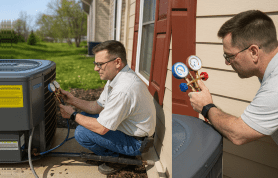
THERE ARE FOUR DISTINCT CATEGORIES OF SECTION 608 TECHNICIAN CERTIFICATION

TYPE I Technician Certification

Authorizes service and repair of small appliances (≤5 lbs refrigerant) such as household refrigerators, window A/C, PTACs, dehumidifiers, vending machines, under-counter ice makers, and water coolers. Focus on safe recovery/handling from factory-sealed, hermetically sealed systems.

TYPE III Technician Certification

Applies to low-pressure appliances operating with refrigerants having liquid-phase saturation pressure < 45 psia at 104°F (e.g., R-11, R-113, R-123, R-245fa). Focus on large chillers, recovery techniques, and emission prevention during maintenance/disposal.

TYPE II Technician Certification

Covers medium, high, and very high-pressure appliances (excluding small appliances and MVAC). Common refrigerants include R-22, R-407A/C, R-410A, and R-502. Emphasis on leak testing, recovery, charging, and safe practices with higher-pressure systems to meet EPA requirements.

UNIVERSAL Technician Certification

Awarded to candidates who pass Types I, II, and III. Qualifies technicians to service all equipment types, from small appliances to high- and low-pressure systems. Requires a minimum score of 70% on each exam section.

Each certification includes testing on EPA-approved core topics such as ozone depletion, recovery, recycling, leak repair, and safety practices. These subjects are fundamental to responsible refrigerant handling and are essential for technicians who want to succeed in the field.

Candidates who prepare seriously for the exam place themselves in a stronger position to pursue employment, improve technical credibility, and demonstrate commitment to high industry standards. For those seeking the broadest professional qualification, the Universal Technician Certification is especially valuable because it confirms competency across all major equipment categories.

NOTE: IDI assumes that the individual taking the certification test possesses prior technical knowledge of refrigeration systems.

Test Section: MorningTest Section: AfternoonTest Section: EveningTest Section: Weekend
Monday-Friday 10:00 A.M. - 6:00 P.M.Monday-Friday 1:00 P.M. - 6:00 P.M.Monday-Friday 6:00 P.M. - 9:00 P.M.Saturday 9:00 A.M. - 5:00 P.M.

*Please call the school to see if the schedule is available

TOTAL COST $199.00

Total Test Cost $199.00

The total cost Includes: The information Booklet, the certification test up 2 times. The third times will be the responsibilities of the applicant.

Section 608 Technician Certification Test Topics

Technician Certification Test Topics

Technicians must pass an EPA-approved test to earn Section 608 technician certification.

Below are some of the topics covered on the tests for each of the four types of technician certification. Universal certification involves topics pertaining to the other three types of certification.

Core

Environmental Impacts

  • Destruction of ozone by chlorine
  • Presence of chlorine in chlorofluorocarbon (CFC) and hydrochlorofluorocarbon (HCFC) refrigerants
  • Identification of CFC, HCFC, and hydrofluorocarbon (HFC) refrigerants (not chemical formulas, but idea that R-12 is a CFC, R-22 is an HCFC, R-134 is an HFC, etc.)
  • Idea that CFCs have higher ozone-depletion potential (ODP) than HCFCs, which in turn have higher ODP than HFCs
  • Understanding of the atmospheric effects from the types of refrigerants
  • Health and environmental effects of stratospheric ozone depletion
  • Evidence of stratospheric ozone depletion and role of CFCs and HCFCs

Clean Air Act and Montreal Protocol

  • CFC phaseout date
  • R-22 phaseout date
  • Venting prohibition at servicing
  • Venting prohibition at disposal
  • Venting prohibition on substitute refrigerants
  • Maximum penalty under the Clean Air Act
  • Montreal Protocol (the international agreement to phase out production of ozone-depleting substances)

Section 608 Regulations

  • Definition/identification of high and low-pressure refrigerants
  • Definition of system-dependent versus self-contained recovery/recycling equipment
  • Identification of equipment covered by the rule (all air-conditioning and refrigeration equipment containing CFCs or HCFCs except motor vehicle air conditioners)
  • Need for third-party certification of recycling and recovery equipment
  • Standard for reclaimed refrigerant [Air Conditioning, Heating, and Refrigeration Institute (AHRI) Standard 700-2016]
  • The sales restriction
  • The Clean Air Act prohibition on venting

Substitute Refrigerants and oils

  • Absence of "drop-in" replacements
  • Incompatibility of substitute refrigerants with many lubricants used with CFC and HCFC refrigerants and incompatibility of CFC and HCFC refrigerants with many new lubricants (includes identification of lubricants for given refrigerants, such as esters with R-134; alkylbenzenes for HCFCs)
  • Fractionation problem--tendency of different components of blends to leak at different rates

Refrigeration

  • Refrigerant states (vapor versus liquid) and pressures at different points of refrigeration cycle; how/when cooling occurs
  • Refrigeration gauges (color codes, ranges of different types, proper use)
  • Leak Detection

Three R Definitions

  • Recover
  • Recycle
  • Reclaim

Recovery Techniques

  • Need to avoid mixing refrigerants
  • Factors affecting speed of recovery (ambient temperature, size of recycling or recovery equipment, hose length and diameter, etc.)

Dehydration Evacuation

  • Need to evacuate system to eliminate air and moisture at the end of service

Safety

  • Risks of exposure to refrigerant (e.g., oxygen deprivation, cardiac effects, frost bite, long-term hazards)
  • Personal protective equipment [gloves, goggles, self-contained breathing apparatus (SCBA)-in extreme cases, etc.]
  • Reusable (or "recovery") cylinders versus disposable cylinders [ensure former Department of Transportation (DOT) approved, know former’s yellow and gray color code, never refill latter]
  • Risks of filling cylinders more than 80 percent full
  • Use of nitrogen rather than oxygen or compressed air for leak detection
  • Use of pressure regulator and relief valve with nitrogen

Shipping

  • Labels required for refrigerant cylinders (refrigerant identification, DOT classification tag)

Type 1 (Small Appliances)

Recovery Requirements

  • Definition of "small appliance"
  • Evacuation requirements for small appliances with and without working compressors using recovery equipment manufactured before November 15, 1993
  • Evacuation requirements for small appliances with and without working compressors using recovery equipment manufactured after November 15, 1993

Recovery Techniques

  • Use of pressure and temperature to identify refrigerants and detect noncondensables
  • Methods to recover refrigerant from small appliances with inoperative compressors using a system-dependent or "passive" recovery device (e.g., heat and sharply strike the compressor, use a vacuum pump with non-pressurized recovery container)
  • Need to install both high and low side access valves when recovering refrigerant from small appliances with inoperative compressors
  • Need to operate operative compressors when recovering refrigerant with a system-dependent ("passive") recovery device
  • Should remove solderless access fittings at conclusion of service
  • Hydrofluorocarbon (HFC)-134a (also called R-134a) as likely substitute for chlorofluorocarbon (CFC)-12 (also called R-12)

Safety

  • Decomposition products of refrigerants at high temperatures

Type 2 (High-Pressure)

Leak Detection

  • Signs of leakage in high-pressure systems (excessive superheat, traces of oil for hermetics)
  • Need to leak test before charging or recharging equipment
  • Order of preference for leak test gases [nitrogen alone best, but nitrogen with trace quantity of hydrochlorofluorocarbon (HCFC)-22 (also called R-22) better than pure refrigerant]

Leak repair requirements

  • Allowable leak rate for commercial and industrial process refrigeration
  • Allowable leak rate for other appliances containing more than 50 pounds of refrigerant
  • Leak repair recordkeeping
  • Extensions to the timeframe to repair leaks that exceed the threshold leak rate

Recovery Techniques

  • Recovering liquid at beginning of recovery process speeds up process
  • Other methods for speeding recovery (chilling recovery vessel, heating appliance or vessel from which refrigerant is being recovered)
  • Methods for reducing cross-contamination and emissions when recovery or recycling machine is used with a new refrigerant
  • Need to wait a few minutes after reaching required recovery vacuum to see if system pressure rises (indicating that there is still liquid refrigerant in the system or in the oil)

Recovery Requirements

  • Evacuation requirements for high-pressure appliances: disposal; major versus non-major repairs; leaky versus non-leaky appliances; appliance (or component) containing less versus more than 200 pounds; recovery/recycling equipment built before versus after November 15, 1993
  • Definition of "major" repairs
  • Prohibition on using system-dependent recovery equipment on systems containing more than 15 pounds of refrigerant

Refrigeration

  • How to identify refrigerant in appliances
  • Pressure-temperature relationships of common high-pressure refrigerants [may use standard temperature-pressure chart--be aware of need to add 14.7 to translate pounds per square inch gauge (psig) to pounds per square inch absolute (psia)]
  • Components of high-pressure appliances (receiver, evaporator, accumulator, etc.) and state of refrigerant (vapor versus liquid) in them
  • The idea that hydrocarbons are not approved for retrofits

Safety

  • Shouldn't energize hermetic compressors under vacuum
  • Equipment room requirements under American Society of Heating, Refrigerating, and Air-Conditioning Engineers (ASHRAE) Standard 15 (oxygen deprivation sensor with all refrigerants)

Type 3 (Low-pressure)

Leak Detection

  • Order of preference of leak test pressurization methods for low-pressure systems: 1. Hot water method or built-in system heating/pressurization device such Prevac; 2. Nitrogen
  • Signs of leakage into a low-pressure system (e.g., excessive purging)
  • Maximum leak test pressure for low-pressure centrifugal chillers
  • Leak inspection requirements for appliances that exceed the leak rate
  • Reporting for chronically leaking appliances

Leak repair requirements

  • Allowable annual leak rate for commercial and industrial process refrigeration
  • Allowable annual leak rate for other appliances containing more than 50 pounds of refrigerant

Recovery Techniques

  • Recovering liquid at beginning of recovery process speeds up process
  • Need to recover vapor in addition to liquid
  • Need to heat oil to 130°F before removing it to minimize refrigerant release
  • Need to circulate or remove water from chiller during refrigerant evacuation to prevent freezing
  • High-pressure cut-out level of recovery devices used with low-pressure appliances

Recharging Techniques

  • Need to introduce vapor before liquid to prevent freezing of water in the tubes
  • Need to charge centrifugals through evaporator charging valve

Recovery Requirements

  • Evacuation requirements for low-pressure appliances: disposal; major versus non-major repairs; leaky versus non-leaky appliances; appliance (or component) containing less versus more than 200 pounds; recovery/recycling equipment built before versus after November 15, 1993
  • Definitions of "major" and "non-major" repairs
  • Allowable methods for pressurizing a low-pressure system for a non-major repair (controlled hot water and system heating/pressurization device such as Prevac)
  • Need to wait a few minutes after reaching required recovery vacuum to see if system pressure rises (indicating that there is still liquid refrigerant in the system or in the oil)

Refrigeration

  • Purpose of purge unit in low-pressure systems
  • Pressure-temperature relationships of low-pressure refrigerants

Safety

  • Equipment room requirements under ASHRAE Standard 15 (oxygen deprivation sensor with all refrigerants)
  • Under ASHRAE Standard 15, need to have equipment room refrigerant sensor for R-123

EPA Section 608 Certification Exam Overview

Demonstrate knowledge of responsible refrigerant handling and federal environmental requirements through the EPA-approved Section 608 technician certification testing process.

Certification Categories

Type I

For small appliances containing five pounds or less of refrigerant.

Type II

For high-pressure and very-high-pressure appliances, excluding specified categories.

Type III

For low-pressure appliances such as qualifying large chillers.

Universal

For candidates who satisfy the applicable Core, Type I, Type II, and Type III requirements.

Important Candidate Information

This page provides certification testing rather than a complete HVAC/R training program. Prior technical refrigeration knowledge is expected, and registration does not guarantee a passing score or certification.

Frequently Asked Questions

What is EPA Section 608 technician certification?
EPA Section 608 certification is required for technicians who maintain, service, repair, or dispose of equipment that could release regulated refrigerants into the atmosphere.
Who needs EPA Section 608 certification?
Technicians who handle regulated refrigerants while servicing or disposing of covered stationary refrigeration and air-conditioning equipment generally need appropriate Section 608 certification.
What certification categories are available?
The page describes Type I, Type II, Type III, and Universal technician certification categories.
What does Type I certification cover?
Type I applies to servicing small appliances containing five pounds or less of refrigerant, including certain household refrigerators, window air conditioners, dehumidifiers, and similar factory-sealed equipment.
What does Type II certification cover?
Type II covers high-pressure and very-high-pressure appliances other than small appliances and motor vehicle air conditioning.
What does Type III certification cover?
Type III applies to low-pressure appliances, including certain large chillers, with emphasis on recovery and emissions prevention.
What is Universal certification?
Universal certification is awarded to candidates who meet the requirements for Types I, II, and III and qualifies the holder across those Section 608 equipment categories.
What topics appear on the exam?
Topics include ozone depletion, Clean Air Act requirements, refrigerant recovery and recycling, leak prevention, safety, substitute refrigerants, oils, and equipment-specific practices.
Is prior refrigeration knowledge expected?
Yes. The page states that IDI assumes the person taking the certification test already possesses technical knowledge of refrigeration systems.
Is this page offering an exam or a full HVAC training program?
This page focuses on the EPA Section 608 technician certification examination and related test information. Candidates seeking broader HVAC/R training should review IDI technical programs separately.
How much does the EPA Section 608 test cost?
The page lists a total cost of $199, including an information booklet and up to two certification-test attempts. Confirm the current price and inclusions with IDI.
Are multiple test attempts included?
The page states that up to two attempts are included and that a third attempt is the applicant’s responsibility. Confirm the current policy before registering.
What test schedules are displayed?
The page displays morning, afternoon, evening, and Saturday testing windows. Contact IDI to confirm actual dates and availability.
Does passing one section provide Universal certification?
No. Universal certification requires successful completion of the applicable Core and Type I, Type II, and Type III exam requirements.
Does registration guarantee that I will pass?
No. Registration, materials, or test attempts do not guarantee a passing score or certification.
How can I register for the test?
Use IDI pre-registration or contact admissions to confirm testing dates, identification requirements, fees, attempt policies, and availability.

Pre-register or contact IDI to confirm testing availability.

Related HVAC/R Programs and Resources

Wendy Admissions Specialist
Wendy
AI Admissions Specialist
1 Wendy AI Admissions Specialist
Wendy
Wendy
AI Admissions Specialist